kathy@kathyschrock.net

Showing posts with label financial literacy. Show all posts

Monday, October 16, 2017

Gamifying financial literacy education with Star Banks Adventure

In the past, I have had the occasion to write blog posts about various aspects of financial literacy. There are many well-done Web sites created by experts in the field of personal finance that can be helpful to ensure students master the financial literacy skillset.


STAR BANKS ADVENTURE GAME

There is now a no-cost, engaging and informational online game from T. Rowe Price titled Star Banks Adventure available for teachers and students to instruct and learn about financial concepts within a gamified environment. Star Banks Adventure is also available as an iOS, Android, and Amazon Fire app. Just go to the Star Banks Adventure game site for links to them all.


The Star Banks Adventure game targets students in grades 5-8 and it includes puzzles and quick quizzes dealing with financial and personal finance concepts and is set in a sci-fi environment. I am not an experienced gamer, but the Star Banks Adventure game provides live demos right within the game, so I was able to catch on quickly how to maneuver and move through the levels. Each level builds upon the concepts in the previous level, so students get a deep-dive into each concept.

TEACHER SUPPORT

The Star Banks Adventure game was intended to help teachers introduce real world money concepts to students in middle school. There is a great curriculum matrix included within the teacher section of the Classroom Edition. The concepts taught in the game are mapped to national standards in personal finance, national standards in economics, and the Common Core State Standards. Below is a section of the curriculum matrix for levels one and two of the Star Banks Adventure game.


T. Rowe Price offers many additional financial resources for educators on their Money Confident Kids site. This site provides background information on financial concepts and includes downloadable magazines for students, print resources, videos, activators, and more. I suggest starting at the Teaching Tools and Activities page of the site, which includes PDF guides for both middle school and high school teachers. The Money Confident Kids site also includes a parent section to help parents reinforce some of these personal finance concepts at home.


CLASSROOM EDITION

The Classroom Edition of the Star Banks Adventure game includes an administrative dashboard for the teacher. Teachers create their own account on this page. In addition to including how-to tutorials for the Dashboard itself, the Dashboard allows the teacher to create online classroom groups, manage these  groups, monitor their students' progress, and compare their students' data with other classrooms in the United States. In the Teacher Dashboard area there are also tutorials introducing each of the six financial concepts included in the game -- setting a financial goal, prioritizing spending, rate of return, asset allocation, inflation and time horizon, and diversification.

Teachers can create as many classrooms as they need in the Dashboard and also view each student's progress and well as the aggregated classroom progress. Students have both a Classroom ID and User ID, neither of which include the real name of the student. Fun pseudonyms for the student names are generated as the teacher creates the User IDs.

Starting at the beginning of the game and moving through the levels helps reinforce the skills as they are learned. However teachers can have students work on a specific subject if they wish and jump to a specific topic.

HARDWARE

I tried out the online version of the game on both Mac and Windows laptops and and on iOS, Android, and Google Fire devices. It worked flawlessly on all of these. It does not seem to run on the Chromebook nor with the Google Play Store install on my Asus Flip Chromebook. 

The Star Banks Adventure game provides a fun, engaging, educational, and informative way for students to learn about personal finance and becoming financially literate. Give it a try with your students!

______________________________________________________________________________________________
This is a sponsored post on behalf of We Are Teachers and T. Rowe Price.
I received compensation for this post, however all opinions stated are my own.
STAR BANKS ADVENTURE and MONEY CONFIDENT KIDS are registered trademarks of T. Rowe Price Group, Inc.

Friday, September 15, 2017

The importance of financial literacy


Financial and economic literacy is about understanding the importance of making appropriate economic choices on a personal level, as well as understanding the connection that personal, business, and governmental decisions have on individuals, society, and the economy.  

I have blogged about programs that help students develop their financial literacy skills. However, it is important teachers are also knowledgeable about the various aspects of financial literacy, as well as the best way to help students attain the knowledge they need to succeed.


OVERVIEW

There is a comprehensive program that can help educators learn about the aspects of personal finance and allows them to earn micro-credentials upon completion of modules and, in some states, credits or points to use for recertification.

Digital Promise, in partnership with the Global Financial Literacy Excellence Center at George Washington University, has developed twenty financial literacy micro-credentials, appropriate for teachers grades 7-12, that provide open access to professional development resources for use across the content areas. These micro-credentials support educators development of their students’ personal finance skills. (If you want to learn more about the process of micro-credentialing, Digital Promise has published a great overview!)


These twenty, competency-based, micro-credentials cover the following.
  • Discussing risk and return
  • Credit cards
  • Buying or leasing
  • Saving for retirement
  • Learning investing
  • Understanding credit scores
  • Financial decision making
  • Building credit
  • Saving strategies
  • Student loan borrowing
  • Tax basics for teens
  • Protecting identity online
  • Comparing banking options
  • Exploring career options
  • Financial management 
  • Comparison shopping
  • Compound interest 
  • Automobile insurance
The modules in the Digital Promise Financial Literacy program include many different modes of learning to help middle and high school students attain the knowledge they need. These include digital game-based learning, online discussions, graphic organizers, learning-by-doing, simulation based learning, problem based learning, applied learning, and performance based learning.

The modules also target the higher order thinking skills as students reactivate their prior knowledge, compare and contrast, analyze, make decisions, and reflect.

THE MODULES


The content of the personal finance program is separated into manageable chunks as modules. I explored all the modules, and wanted to share one that targets content I am passionate about - identity protection. I signed up for my free account at Digital Promise which brought me to their micro-credentialing platform, BloomBoard.

The introduction to the module included an overview of the method of instruction and links to supporting research for the instructional method for this module which is game-based learning. The introduction also included a suggested implementation of the lesson as well as links to a choice of digital games to use for the lesson.

This was followed by a list of the submission requirements for evaluation and earning of the micro-credential. These are shown below and also included a downloadable document which included the scoring guide rubric.


Once I had read the background material and investigated the included online financial games, I felt confident to teach the lesson about identify theft to the students. I would allow them to complete one of the games and then to collaborate in pairs, and with the class, about their experiences and gained knowledge.

To attain the micro-credential, I needed to go back to the questions above and complete the sections discussing how I introduced the topic, upload two artifacts, and (the most important part) reflect on game-based learning and its impact on student acquisition of content. There was also an optional survey to provide the resource creators with additional information.

I was very impressed with both the content and the platform of the module. The choices included allowed me, as an educator, to determine what was best for my students. The included research information and additional resources made me feel comfortable I had attained enough knowledge to teach the topic in an way to help students learn. The assessments to earn my micro-credential were meaningful and prompted me to think and reflect on both the method of delivery and student learning.

The Digital Promise/GFLEC financial literacy program can be used across the curriculum, and, in addition to helping students attain the financial literacy skills, it provides educators with the time to reflect on methods of instructional delivery, which can help frame practice in any content area!
_________________________________________________________
This is a sponsored post on behalf of We Are Teachers and Digital Promise
I received compensation for this post, however all opinions stated are my own.


Friday, April 08, 2016

Financial Literacy for All

April is Financial Literacy Month. Financial literacy is one of the literacies our students need to succeed. Financial and economic literacy are about understanding the importance of making appropriate economic choices on a personal level, as well as understanding the connection that personal, business, and governmental decisions have on individuals, society, and the economy. How can you ensure students master the financial literacy skill-set?


The PricewaterhouseCoopers (PwC) Charitable Foundation offers a online comprehensive financial literacy program designed for students in grades 3-12. The content of the program is aligned with the Council for Economic Educators standards.

Students engage with financial literacy concepts through innovative self-paced modules featuring custom videos, animations, and interactive activities. The curriculum is called Earn Your Future Digital Lab


The modules are broken up into three levels-- Beginner, Intermediate, and Advance. Each set of modules include items of interest to students at their level. (The beginner level for grades 3-5 will not be launched until fall of 2016.)

Here is a screenshot of the modules for the Intermediate Level.


Intermediate level financial literacy modules

I logged in as a student and picked intermediate module three, "Can I Afford a Phone?" The module can be completed all in one sitting, or students can go back to a section later to finish it.

I completed the module using a laptop computer, but then went back and tested it with an iPad. Everything seemed to function perfectly on the tablet. Of course, since the site is Web-based, it should work fine with Chromebook and the Surface, too.

The module started off with a video of a clever texting session between a teenager and their parent. During the texting session, the parent gives the responsibility to their teenager to do the research for the best phone and also to figure out the costs of affording a new phone.


The module continues with sound advice on how the student might proceed and offers a commonsense plan on how the teenager might approach the problem. 


This is followed up with a quiz about spending and budgets to gauge what the student already knows. After answering each question, the student is provided with additional information if they answer incorrectly but also with clarifying information if they answer correctly.


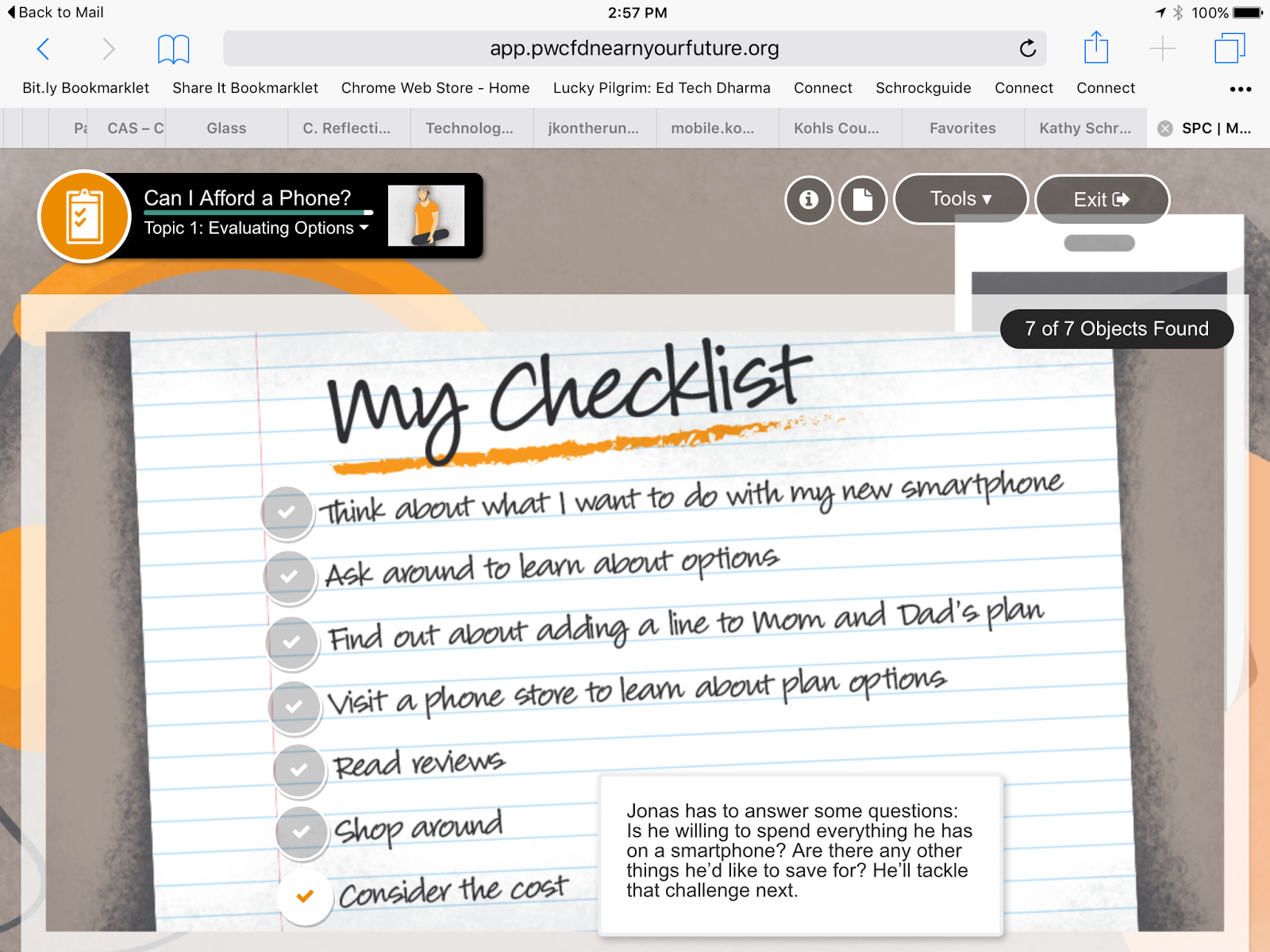
The next component of the module is very engaging. Students pick an avatar to "become" the teenager who wants the cell phone. This is followed up with a checklist of tasks to research the phone purchase (with a pop-up for each item) and time is left for reflection by the student and a short two-question quiz.


The module then moves into teaching the budgeting process so students can apply the process to the teenager's research. The students can utilize the included calculator tool to determine if the teenager can successfully create a budget that allows him to purchase the new smartphone. There is a computation piece included with some simple math problems and a review of income vs. fixed expenses vs. variable expenses. 

There is a fun final activity that allows the students to build a balanced budget for the teenager. The interesting part is, as the student eliminates unnecessary expenses, there are pop-ups with unexpected expenses or income, like a library fine or income from babysitting. This component truly simulates what this is like in real-life and teaches the students the difference between wanting something and being able to afford it.


There is a wrap-up of the module with a nice overview of the processes taught and including some extension tips for dealing with budgeting throughout their lives for purchasing a home, saving for retirement, etc.


The final component of the module is the post-test, which includes several types of summative assessments. The post test should only take about ten minutes, and, at the completion, the student earns a badge to show the module is completed.


The Advanced modules, intended for high school students, also include real-life videos starring teenagers. This makes the modules even more engaging for the students.


After the student has completed the modules, the site also provides additional resources to build-upon the skills practiced in the program including planning for college, home buying, risk management and insurance, planning and money management, and more.


SET-UP PROCESS


To give students access to the site, the teacher or home school parent creates a teacher account on the site.

Once logged-in, the teacher creates a default password for all of the student accounts. When a default password is set, students will be asked to create a personal password on their first login.

Student names can be entered manually or uploaded via a CSV file.


The teacher then creates a class and picks students to add to the class.


Teachers then provides students with the the URL to the PwC Charitable Foundation Earn Your Future Digital Lab site, their username and the default password. Students can log-in to the site and work on the modules.

One suggestion, to make sure students stay on task and complete the modules they pick to complete is to have the student print out their "badges" page which will show the completed modules.

SUMMARY

The PwC Charitable Foundation Earn Your Future program is brand new and additional features are planned for the near future. These include handbooks and module planning tools for the teacher and the ability to provide feedback to students via embedded assessment tools.

If you want to engage your students in learning more about personal finances, whether in April or throughout the year, the PwC Charitable Foundation curriculum, Earn Your Future, is a wonderful way to engage students and help them practice and learn useful, life-long skills!


This is a sponsored post on behalf of We Are Teachers and the PwC Charitable Foundation
I received compensation for this post, however all opinions stated are my own.

Monday, December 14, 2015

H&R Block Budget Challenge: Get your class involved!


I first posted back in July about the H&R Block Budget Challenge and included links to financial literacy sites to use in the classroom. There is still time to enroll your high school or high-school age homeschool class in this great contest which helps students learn and, more importantly, practice personal financial literacy, as well as offering teachers and students a chance to win grants and scholarships!  

The H&R Block Budget Challenge immerses high-school students in the life of a recent college graduate who has been working for six months. Each participant receives a virtual salary and must make smart budgeting decisions regarding expenses, such as rent, utilities, car payments and more. Students are challenged to balance current and future financial needs and demonstrate resourcefulness, understanding and practical application of financial concepts

There are six rounds of the H&R Block Budget Challenge, and there are still three rounds left to participate in, so sign your class up today! The closing dates for registration for the remaining three simulations are January 7, January 21, or February 4, 2016.


The H&R Block Budget Challenge encourages students to learn personal finance in a fun, engaging way while competing against other classrooms and students for $3 million in classroom grants and student scholarships. These awards include 60 chances for classroom grants up to $5000, 132 chances of student scholarships of $20,000, and a grand prize student scholarship of $100,000!

http://hrbds.org


Since I believe financial literacy is one of the important literacies our students should attain before they graduate high school, I have blogged about ideas to enhance this across the curriculum, and I consider financial literacy one of the thirteen essential literacies. 

The H&R Block Web site also includes Budget Challenge lesson plans and student activities educators can use in the classroom. The H&R Block Budget Challenge and these lesson plans target Common Core standards for English language arts and mathematics, as well as personal finance benchmarks established by the Council for Economic Education (CEE) and the Jump$tart Coalition for Personal Financial Literacy

FINANCIAL LITERACY INFOGRAPHICS

Once students have completed the H&R Budget Challenge, you can continue the financial literacy instruction by the use of infographics. After participating in the H&R Block Budget Challenge, the students will have the knowledge base to determine the usefulness, validity, and information included in these types of infographics. In addition, you can have students re-create the infographics by including new data, a different focus, or research data they have collected. (Additional information on how to use infographics in the classroom may be found on my Web page here.)

Here are some infographics and Google search links to get students started.

http://newsroom.mastercard.com/photos/road-to-inclusion-money-management/


http://blogs.usda.gov/2013/08/14/what-does-it-cost-to-raise-a-child/


http://www.moneymanagement.org/Budgeting-Tools/InfoGraphics/Kids-and-Money.aspx


Sign your class up today for the H&R Block Budget Challenge

This is a sponsored post on behalf of We Are Teachers and H&R Block
I received compensation for this post, however all opinions stated are my own.


Thursday, July 30, 2015

H&R Block Budget Challenge: Get ready!

I truly believe financial literacy is one of important literacies our students should attain before they graduate high school. I have blogged about ideas to enhance this across the curriculum and consider it one of the thirteen essential literacies. 

Students are often taught, in a social studies class or a economics class, about the impact the decisions made by businesses and government have (and have had) on society and the economic climate. Students study capitalism, the Great Depression, War Bonds, government bail-outs of corporations, manufacturing, and other related events..

However, the area that is often overlooked is the personal finance component of financial literacy. Sometimes, how to develop a budget is taught in a math class when learning about spreadsheets. And I remember working in pairs in my high school health class while we developed a budget for a wedding. But there is not often a systemic curriculum for real-life applications of personal finance, especially in this digital age. Learning how to balance a checkbook is great, but what about online banking and investing? Planning for retirement? Paying taxes?


H&R Block provides a wonderful contest each year. the H&R Budget Challenge, that both helps students learn and practice personal financial literacy, as well as offers their teachers and themselves a chance to win grants and scholarships! 


The H&R Block Budget Challenge is a free online contest with the goal to teach students strong budgeting skills and fiscal discipline. The contest encourages students to learn personal finance in a fun, engaging way while competing against other classrooms and students for $3 million in classroom grants and student scholarships! These awards include 60 chances for classroom grants up to $5000, 132 chances of student scholarships of $20,000, and a grand prize student scholarship of $100,000.


The Budget Challenge is a teen financial literacy program in the form of an online game that simulates real life financial and personal money planning of budgets, retirement, taxes, and more. The Budget Challenge is open to students 14 years of age or over in grades 9-12. There are multiple start dates for the competition (first one starting September 10 and last one over April 21) so it would be easy to fit into your curriculum when you see fit. Answers to all your questions about the Budget Challenge may be found here: http://www.hrblockdollarsandsense.com/

Students will all need a personal email account, teachers are required to inform student parents/guardians about the program and prizes. and also subscribe to the educator mailing list for the contest.

There is both an iOS and and Android app available to help students keep track of their progress in the H & R Block Budget Challenge and students can also access the information through the Web site when using a computer or Chromebook.

Budget Challenge App screenshots


GET READY FOR THE BUDGET CHALLENGE

I know if I was signing my class up to participate in the H&R Block Budget Challenge, I would want to have them prepared with some background information.

There are online materials and sets of state standards to help teachers develop lessons and units dealing with personal finance into and across the curriculum. I have included resources in the my blog post, but I especially like the Council for Economic Education's set of standards for financial literacy which cover skills for grades 4, 8, 9 and 12.

  • Earning income
  • Buying goods and services
  • Using credit
  • Saving
  • Financial investing
  • Protecting and insuring

There are also apps and interactive online sites that can get your students ready for the H&R Block Budget Challenge!

Lesson plans created by teachers for previous years of the H&R Block Budget Challenge can be found on the Budget Challenge site here. These will give you some idea of the types of lessons that can be designed.

Thrive and Shine is a app that teaches teens and young adults about personal finance. It is available for the iOS and Android platforms as well as a Web app. The site includes a curriculum and ideas for teachers, too.

Thrive and Shine screenshot


Unleash the Loot! is an iPad app that is intended for grades 5-8, but would be fun for the high school students to play, too. It can help them realize the basics of personal literacy such as setting goals, budgeting, earning money, saving and spending, and giving to charity.

Unleash the Loot! screenshot

The Mint.org online site includes interactive scenarios for kids and teens to work through to learn about personal financial literacy. This  site also offers tips and tricks, especially for teens, in the areas of earning, saving, spending, owing, tracking, giving, investing, and safeguarding.


The Practical Money Skills for Life site by Visa includes some short interactive games to help students budget. One is called "Road Trip for Savings" and you have to collect money by doing "chores" as you drive across the US. I never was able to get anywhere, running out of money for gas and insurance, but students would probably do just fine!


There are other games on the site including two well-created sports games, Financial Soccer and Financial Football (also available for iOS), that have students answering questions in order to advance up the field to score. For iOS and Android, there is a Plan'it Prom app for both iOS and Android to help students and parents budget for the prom!

I hope you sign up for the H&R Block Budget Challenge and encourage your students to participate!

Monday, September 01, 2014

Literacies for the digital age: Financial literacy


I have identified thirteen literacies important for students to master..  Lisa Nielsen, in her blog post “Should the new math be financial literacy?” states “we have lost focus on preparing young people for what will matter in their real lives. If the education system were to provide some financial literacy classes for kids, it could make a tremendous difference in the economic success of society”. Let’s examine some ways you can easily embed their literacies across the curriculum.
whiteline_discoverwhiteline_discover
Economic literacy, often called financial literacy, according to Atomic Learning, “targets the importance of making appropriate economic choices on a personal level, and understanding the connection personal, business, and governmental decisions have on individuals, society, and the economy”. The report of the NASBE Commission on Financial and Investor Literacy also offers a useful definition: “Financial literacy is defined as the ability to read, analyze, manage and communicate about the personal financial conditions that affect material well-being. It includes the ability to discern financial choices, discuss money and financial issues without (or despite) discomfort, plan for the future and respond competently to life events that affect everyday financial decisions, including events in the general economy”.


STANDARDS

Some states, such as Ohio, have an economic and financial literacy requirement in their Ohio Core state standards to be taught within social studies or another class. In their state, teachers certified in social studies, business education, marketing education, and family and consumer science are all licensed to teach financial literacy. These teachers can help develop a curriculum starting in the earliest grades to make sure these literacies are woven seamlessly throughout the curriculum at all grade levels.
The Council for Economic Education has developed a set of standards for financial literacy that start in grade three.
The strands include:
  • Earning income
  • Buying goods and services
  • Using credit
  • Saving
  • Financial investing
  • Protecting and insuring
Of course, financial literacy strands are also found in the National Business Association’s standards, the American Association of Family and Consumer Sciences standards,  and state standards, such as the ones in Ohio, Oklahoma (7-12), Nebraska (K-12) and New Jersey (4-12). There are even sets of standards, such as the Jump$tart Coalition’s National Standards in K-12 Personal Finance Educationthat can serve to help you embed economic and financial literacy across the curriculum.

ONLINE RESOURCES

In addition to economic and financial literacy associations, there are investment firms, banks, and government agencies who provide both online and offline material to help you weave financial literacy across the curriculum.
  • Council for Economic Education: EconEdLink Personal Finance
    • Includes lesson plans, up-to-date information, economic data and Web links for educators
    • Interactive tools and lessons for students
  • Federal Financial Literacy and Education Commission (US):  MyMoney.gov
    • Information, games and fun facts about money, saving and planning for the future
    • Curricula, lesson plans, tip sheets, guidance and helpful tools for teaching financial capability
    • Clearinghouse of federally-funded research reports, articles and data sets on financial capability and related topics
  • United States Mint: Financial Literacy
    • Activities and lesson plans about coin to promote basic economic understanding for students
  • Fox Business: The Centsables
    • A cable program support page with comic books dealing with financial literacy topics
  • Federal Reserve Bank (US): Lesson Plans
    • Lesson plans for K-12 dealing with financial literacy; includes a literature tie-in
    • Games and simulations for K-12 students
  •  Northwestern Mutual Life Insurance Company: The Mint
    • Interactive scenarios for kids and teens dealing with saving, spending, protecting, and entrepreneurship
  • H&R Block: Dollars and Sense
    • Provides and gathers ideas, news, tips, and tricks for teachers and students in the area of investing and savings
  • University of Nebraska- Omaha Center for Education: Economic Education Web
    • K-12 concepts and lessons plans for economic and financial literacy as well as links to data sets
    • Special THEN (Teach History and Economics in Education), a 4th grade curricular tie-in
  • Canadian Centre for Financial Literacy: Activity worksheets
    • A curriculum for financial literacy with a handbook and worksheets for adults or high schoolers
Have you used any of these financial literacy sites with your students? Share your ideas on Twitter! #kathyschrock